

B2B companies have more ways than ever to attract potential customers. Search engines, paid advertising, social media, email marketing, webinars, content marketing, and events can all generate leads. Yet more leads do not necessarily mean more revenue.
For many B2B organizations, the more important question is:
Should we aim to generate as many leads as possible, or focus our marketing efforts on a specific group of high-value accounts?
This is the fundamental difference between traditional lead generation and Account-Based Marketing (ABM). Traditional lead generation typically casts a wider net, attracting potential customers and then qualifying them through the sales process.
ABM takes the opposite approach. Instead of starting with a large audience and narrowing it down, businesses identify strategically valuable accounts first and then build highly targeted marketing and sales activity around them.
Neither approach is universally better. The right choice depends on the company’s market, sales cycle, customer value, resources, and growth objectives. For many B2B businesses, however, the most effective strategy may be a combination of both.
What Is Traditional B2B Lead Generation?
Traditional lead generation is designed to attract a broad pool of potential customers.
The process typically looks like:
Audience → Marketing Campaign → Lead → Qualification → Sales Opportunity → Customer
Marketing may use:
- SEO
- Google Ads
- LinkedIn advertising
- Content marketing
- Email marketing
- Webinars
- Social media
- Landing pages
- Lead magnets
- Industry events
The objective is to generate sufficient interest to create a pipeline of potential customers. Once leads enter the marketing or sales funnel, they are qualified based on criteria such as company size, industry, budget, location, business need, and purchase intent. This model can be extremely effective when the company has a large addressable market and a relatively scalable sales process.
What Is Account-Based Marketing?
Account-Based Marketing reverses the traditional funnel.
Rather than asking:
“How can we generate more leads?”
ABM asks:
“Which companies do we most want as customers?”
The organization compiles a list of high-value target accounts and develops marketing strategies tailored to those businesses.
The process becomes:
Target Accounts → Personalised Engagement → Multiple Stakeholders → Sales Opportunity → Customer
Target accounts might be selected based on:
- Revenue potential
- Industry
- Geographic location
- Company size
- Technology stack
- Existing relationships
- Strategic importance
- Expansion potential
- Likelihood to purchase
ABM is particularly useful when a small number of customers account for a significant share of revenue.
The Key Difference: Quantity vs Quality
The simplest way to understand the distinction is:
Traditional lead generation prioritizes reach and volume.
ABM prioritizes relevance and account value.
Imagine two B2B technology companies. Company A sells a €2,000-per-year software product to thousands of businesses.
Company B provides a €250,000 enterprise technology solution to large organizations. Traditional lead generation may be highly effective for Company A because it needs a large volume of prospects.
Company B may benefit more from ABM because winning a small number of carefully selected accounts could have a significant impact on revenue. The business’s economics, therefore, influence the appropriate marketing strategy.
Traditional Lead Generation: The Advantages
Traditional lead generation offers several important benefits.
1. Greater Market Reach
A broad digital marketing strategy allows businesses to reach a large potential audience. This is particularly useful when the company is still discovering which customer segments respond best to its proposition.
2. Scalable Acquisition
Digital campaigns can potentially reach thousands of prospects without requiring the marketing team to create individual strategies for every account.
3. Market Discovery
Lead generation can reveal unexpected customer segments. A business may discover that a product designed for one industry is attracting significant interest from another. This can be valuable market intelligence.
4. Easier Automation
Many lead-generation processes can be automated through:
- Marketing automation
- Email campaigns
- Lead scoring
- CRM workflows
- Paid advertising
- Automated content journeys
This allows relatively small marketing teams to manage large audiences.
5. Strong Top-of-Funnel Growth
For companies focused on increasing brand awareness and expanding their addressable market, broad lead generation can provide the reach required to grow.
Traditional Lead Generation: The Limitations
The biggest weakness is that lead volume can become a misleading success metric.
A campaign might generate hundreds of leads while producing very little revenue.
Common problems include:
- Low-quality enquiries
- Unqualified prospects
- High customer acquisition costs
- Poor conversion rates
- Long sales cycles
- Misalignment between marketing and sales
- Large volumes of leads that never become opportunities
Marketing teams can therefore end up optimizing for the wrong outcome. Generating 1,000 leads sounds impressive. Generating 20 qualified opportunities worth €2 million in the pipeline is potentially much more valuable.
Account-Based Marketing: The Advantages
ABM addresses some of these problems by focusing resources on accounts that matter most.
1. Better Alignment Between Marketing and Sales
ABM requires marketing and sales to agree on target accounts and work toward shared objectives.
This can reduce the traditional disconnect between:
Marketing: “We generated 500 leads.”
and
Sales: “None of them are the right prospects.”
ABM instead creates a shared question:
“How do we win these specific accounts?”
2. Higher Relevance
ABM allows businesses to tailor messaging to specific industries, organizations, and business challenges.
A generic campaign might say:
“Improve your digital infrastructure.”
An ABM campaign could address a specific business challenge:
“How [target company] can modernize its eCommerce infrastructure while expanding into new markets.”
The second message is much more relevant to the intended audience.
3. Multiple Stakeholder Engagement
Large B2B purchases rarely involve one person.
ABM allows marketers to engage different stakeholders within the same organization.
For example:
CEO: Business growth and strategic value.
CFO: ROI and cost efficiency.
CTO: Technology and integration.
Procurement: Commercial terms.
Operations: Implementation and usability.
Instead of treating the organization as one lead, ABM treats it as a buying group.
4. Better Use of Marketing Resources
A company with limited resources may achieve better results by concentrating its efforts on 100 high-value accounts rather than trying to reach 100,000 prospects. This can be particularly valuable for enterprise B2B businesses.
5. Potentially Higher Customer Value
Because ABM focuses on strategically important accounts, it can support larger deals, longer-term relationships, and account expansion.
Account-Based Marketing: The Limitations
ABM is not a magic solution.
It requires greater planning and coordination.
1. Smaller Addressable Audience
Focusing on a defined account list naturally reduces reach.
This can make ABM unsuitable for businesses that require very high transaction volumes.
2. More Resources Per Account
Personalization requires time.
Marketing teams may need to create:
- Account-specific content
- Personalized landing pages
- Industry-specific campaigns
- Targeted advertising
- Bespoke email sequences
- Sales enablement materials
The investment can be substantial.
3. Requires Strong Data
ABM depends on knowing which companies represent attractive opportunities. Poor CRM data, inaccurate company information, or incomplete stakeholder information can undermine the strategy.
4. Longer Sales Cycles
Enterprise ABM campaigns can take months or even years to produce results. Companies need realistic expectations and appropriate measurement frameworks.
The Three Levels of ABM
ABM does not always mean creating an entirely bespoke marketing strategy for every account. There are generally three levels of sophistication.
One-to-One ABM
The highest level of personalization. The company creates a highly customized strategy for a small number of strategically important accounts. This might include bespoke research, content, messaging and outreach.
Suitable for:
- Major enterprise prospects
- Large strategic accounts
- High-value opportunities
One-to-Few ABM
Accounts are grouped into clusters with similar characteristics.
For example:
European financial services companies with more than 1,000 employees.
Marketing can create highly relevant campaigns without developing completely separate strategies for every organization.
One-to-Many ABM
A larger group of target accounts receives a scalable but still highly targeted campaign. Technology platforms and advertising tools can help deliver personalized messaging at greater scale. This approach sits between traditional demand generation and highly personalized ABM.
Which Strategy Works Best?
The answer depends on the business.
Traditional Lead Generation Is Often Better When:
- The target market is large.
- Average contract values are relatively low.
- Sales cycles are short.
- The company needs high lead volume.
- The product is relatively easy to understand.
- Customer acquisition can be automated.
- The business is still identifying its ideal customer profile.
ABM Is Often Better When:
- Average contract values are high.
- The target market is relatively concentrated.
- Sales cycles are long.
- Multiple stakeholders influence purchases.
- Enterprise customers represent significant revenue.
- Sales and marketing resources are limited.
- The business has clearly defined ideal customer profiles.
Why the Best Strategy May Be Both
The biggest mistake is treating ABM and traditional lead generation as mutually exclusive. They can work together.
A B2B company might use broad digital marketing to create awareness and identify potential demand. From that activity, marketing can identify high-value accounts. Those accounts can then enter an ABM program.
The strategy becomes:
Broad Demand Generation
Identify High-Value Accounts
Account-Based Engagement
Sales Opportunity
Customer
This creates a powerful combination of reach and precision.
A Practical B2B Marketing Framework
A hybrid strategy could divide the market into three groups.
Tier 1: Strategic Accounts
A small number of extremely valuable accounts.
Use one-to-one ABM.
Tier 2: Priority Accounts
A larger group of high-potential organizations.
Use one-to-few ABM campaigns.
Tier 3: Broader Market
The remaining addressable audience.
Use scalable SEO, paid advertising, content marketing, and demand generation.
This creates a marketing model that allocates resources according to potential customer value.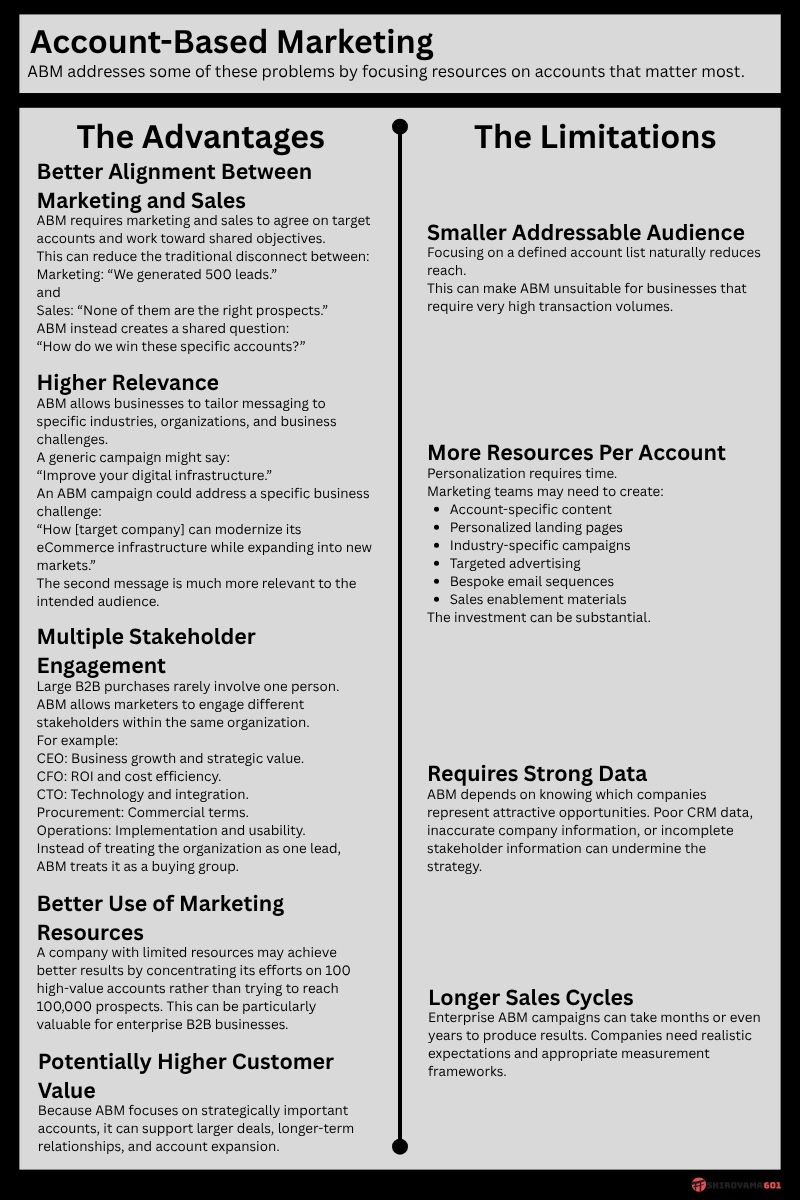
How Data Makes ABM More Effective
Data is central to both lead generation and ABM.
Businesses can combine:
- CRM information
- Website behaviour
- Advertising engagement
- Email activity
- Firmographic data
- Industry information
- Technology data
- Sales activity
- Previous customer relationships
This helps identify which accounts are showing meaningful buying signals.
For example, a target company may suddenly:
- Visit several product pages.
- Download technical documentation.
- Engage with LinkedIn content.
- Attend a webinar.
- Return to the website multiple times.
Individually, each interaction may be insignificant.
Collectively, they may indicate increasing purchase intent.
This allows sales and marketing teams to prioritize accounts based on evidence rather than assumptions.
Measuring ABM vs Lead Generation
The metrics should reflect the strategy.
Traditional lead generation may focus on:
- Website traffic
- Leads
- Cost per lead
- Conversion rate
- MQLs
- SQLs
ABM should focus more heavily on:
- Target-account engagement
- Stakeholder engagement
- Account penetration
- Meetings generated
- Opportunities created
- Pipeline value
- Win rate
- Customer acquisition cost
- Revenue per account
- Account expansion
This is important because ABM may produce fewer leads while generating substantially more valuable opportunities.
The Most Important Metric: Revenue
Ultimately, both strategies should be judged against commercial outcomes.
Marketing should be able to connect activity to:
Qualified opportunities → Pipeline → Closed revenue
The objective is not to prove that ABM generates more leads. It probably should not. The objective is to determine whether ABM generates better business outcomes from the resources invested.
How to Decide Which Approach to Use
Before choosing a strategy, ask six questions.
1. What is our average customer value?
The higher the value, the more attractive ABM becomes.
2. How many potential customers exist?
A concentrated market lends itself to ABM.
A huge addressable market may benefit from scalable demand generation.
3. How long is our sales cycle?
Long and complex sales cycles often benefit from account-based engagement.
4. How many stakeholders are involved?
The more complex the buying committee, the more useful ABM can become.
5. How much personalization can we realistically deliver?
ABM requires resources, data and coordination.
6. What does our sales team actually need?
Marketing strategy should support the commercial process rather than operate independently from it.
The Future of B2B Marketing Is More Account-Aware
The distinction between lead generation and ABM is likely to become less rigid. Technology increasingly allows companies to identify organizations rather than simply individual leads.
AI, CRM platforms, marketing automation, intent data and behavioral analytics can help businesses understand which accounts are researching specific problems and which stakeholders may be involved.
This creates an opportunity to move from:
“Who filled out our form?”
toward:
“Which organizations are demonstrating buying intent, what are they interested in, and how can we help them?”
That is a much more strategic approach to B2B marketing.
Final Thoughts
There is no universal winner between Account-Based Marketing and traditional lead generation. Traditional lead generation is powerful because it provides reach, scalability, and market discovery.
ABM is powerful because it provides focus, relevance and closer alignment between marketing and sales. The right strategy depends on the business’s economics and complexity.
For companies selling lower-value products into broad markets, traditional demand generation may remain the most efficient approach. For organizations selling complex, high-value solutions to a defined group of enterprise customers, ABM can deliver significantly greater strategic value.
For many B2B businesses, however, the strongest approach is a combination of both. Use broad marketing to create awareness and discover demand. Use data to identify the accounts that matter most. Then use ABM to turn those accounts into relationships, opportunities, and revenue. The future of B2B marketing is not about generating the maximum number of leads. It is about creating the right relationships with the right organizations at the right time.
Key Takeaways
- Traditional lead generation prioritizes reach and lead volume.
- Account-Based Marketing prioritizes high-value accounts and relevance.
- Neither approach is universally better; the right model depends on the business.
- ABM is particularly effective for complex, high-value B2B sales.
- Traditional lead generation works well for large addressable markets and scalable products.
- ABM can improve marketing and sales alignment by creating shared target accounts.
- Large B2B purchases require marketers to engage multiple stakeholders within an organization.
- Data and behavioral signals can help identify accounts demonstrating purchase intent.
- ABM should be measured by account engagement, opportunities, pipeline, and revenue rather than by lead volume alone.
- A hybrid strategy can combine broad demand generation with targeted account-based campaigns.
- Ultimately, the goal is not simply to generate more leads; it is to generate more valuable customers and sustainable revenue.

Know Your Market
Shiroyama 601 is invested in your success. We provide you with current news and updates about B2B marketing, PSP technology, leadership consulting and business development in our weekly blog.
Our experienced writers research the latest industry developments and deliver their opinions. Shiroyama 601writers do not accept any outside payments or gratuities for their posts. Everything they compose is of their own opinion, based on their own research.
Keep up to date with our blog and keep up to date with what’s happening behind the scenes in the industry.